🌾 When Truth Walked Through the Four Ages
A quiet story across Satya, Treta, Dvapara and Kali —
and what it reveals about us today.
There is an old story, whispered across the Puranas,
that Truth is not a fixed rock —
it is a traveler.
It walks with us through every age.
And like us,
it changes its shape to survive.
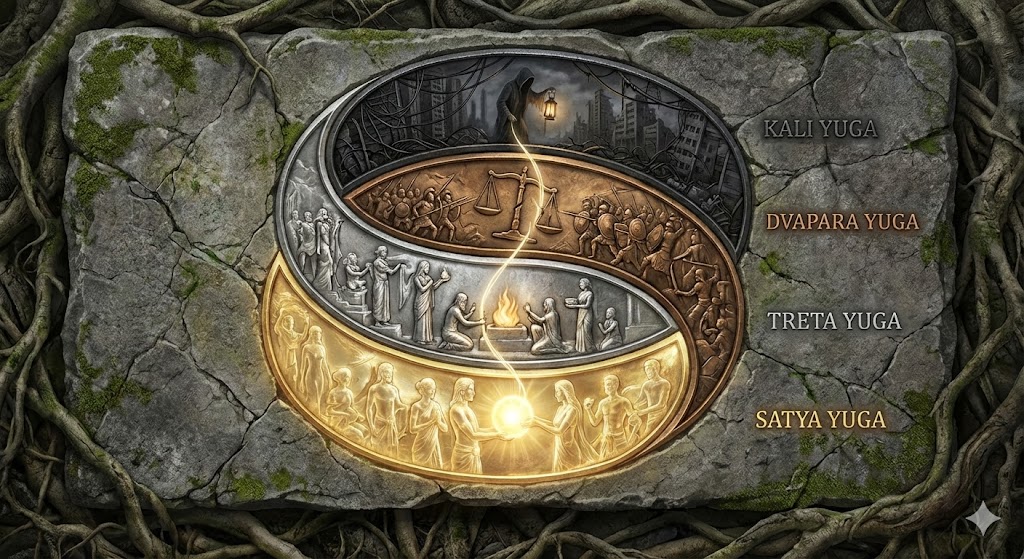
This is the story of how Truth started as light,
became law,
turned into strategy,
and finally settled inside the fragile chambers of the human heart.
1. Satya Yuga: When Truth Lived Inside the Soul
They say in Satya Yuga, people didn’t “practice” truth.
They were truth.
Life was simple.
Desires were quiet.
The mind and the heart were not two separate voices.
If a person said “I will do this,”
the universe knew it was already done.
There was no gap between intention and action.
A sage once described that time saying,
“It was like walking in a world made of sunlight.
Every being shone from the inside.”
In modern language —
Satya Yuga was a time of inner alignment.
Psychology would call it
a state of integrated consciousness,
no ego, no fragmentation.
Sociology would say
the world was small enough
that people did not need masks.
Truth lived inside the Self.
2. Treta Yuga: When Truth Became a Social Promise
As time moved, society grew larger.
Villages became kingdoms.
Roles became responsibilities.
People lived for more than themselves.
In this age walked Rama,
the one who carried truth like a lamp in his hand.
His truth was not only for himself —
it was a commitment to father, kingdom, family, and people.
In Treta Yuga,
truth stepped outside the person
and became a social agreement.
Psychology would call it
role-based identity:
you speak as a son, king, brother, leader.
Sociology would say
society became complex enough
that truth needed rules.
Treta taught us that
truth is not only who we are,
but how we behave with others.
3. Dvapara Yuga: When Truth Became Context
By the time Krishna arrived,
the world had become too complicated for simple truths.
People had different intentions,
kingdoms had conflicting dharmas,
and moral dilemmas tangled between families, politics, and survival.
This was the age of context.
Krishna did not lie to cheat.
He lied to protect.
He bent truth to preserve life.
He used silence when words were dangerous,
and laughter when anger was pointless.
In Dvapara Yuga,
truth transformed into wisdom —
the ability to see what serves the larger good in each moment.
Psychology calls this
cognitive flexibility —
a mature mind that adapts truth to context.
Sociology sees it as
negotiation ethics:
truth becomes fluid when systems collide.
Dvapara taught us:
Truth is not only what is said,
but why it is said.
4. Kali Yuga: When Truth Returns to the Individual
Then came our time — Kaliyuga.
Where complexity reached its peak
and community began to fragment
into identities, beliefs, opinions, and personal stories.
The world became a mirror maze:
everyone sees their own reflection
but not the whole picture.
Truth became personal.
Private.
Emotional.
Subjective.
A person today might say:
“This is my truth.”
And it may be completely different from yours.
Not wrong — just personal.
Psychology calls this
the age of identity-driven truth.
Sociology calls it
the era of hyper-individualism.
Mythology simply calls it
the time when only one-fourth of truth remains in the world.
Kali Yuga teaches us:
Truth is shaped by our experience
because society is too fragmented
to hold one collective truth.
✨ So why does truth change across the ages?
Because human consciousness is evolving
through layers of complexity.
- When life was simple →
truth could be pure. - When society became structured →
truth became duty. - When systems clashed →
truth became contextual. - When individuals took center stage →
truth became personal.
Truth evolves
because our minds, our communities, and our conflicts evolve.
Yet the deeper pattern remains unchanged:
Truth always adjusts itself
to the level of human maturity
and the shape of human society.
🌙 A Quiet Reflection
When I look at our world today,
I feel we are not losing truth —
we are simply carrying it differently.
The pilgrim in us wants inner clarity.
The citizen in us wants social harmony.
The warrior in us wants contextual wisdom.
And the seeker in us wants personal meaning.
Maybe the journey of truth through the yugas
is not a decline,
but a deepening —
an invitation to rediscover
what sits beneath our personal truths.
A place where
the Satya of purity,
the Treta of duty,
the Dvapara of wisdom,
and the Kali of experience
meet in one single moment:
now.